

In 2025, Official Development Assistance (ODA) from Development Assistance Committee (DAC) members, also referred to as the donor club of some of the world’s wealthiest nations, fell by 23.1% according to data released in April 2026 by the Organisation for Economic Co-operation and Development (OECD). Bilateral grants bore the steepest cut at 29.1%, while humanitarian aid collapsed by 35.8%. The numbers are stark – this data reveals the largest single-year contraction recorded in the history of international aid. Currently, ODA is increasingly being reshaped as a lever for mobilizing private capital by securing commercial returns and advancing donor geopolitical agendas. These have profound implications for the Global South, which ultimately present challenges to the current international system of development cooperation.
As headline ODA volumes decline, Asia-Pacific’s three largest DAC donors: Japan, South Korea, and Australia are increasingly relying on the private finance architecture that includes blended finance instruments and infrastructure financing facilities, reshaping aid as a vehicle for capital mobilization.
JAPAN
Japan’s ODA in 2024 was $16.8 billion, or 0.35% of Gross National Income (GNI), declining to $16.2 billion, or 5.6%, in 2025. The main private finance instrument is Leading Asia’s Private Infrastructure Fund 2 (LEAP 2), a $1.5 billion infrastructure fund established by Japan International Cooperation Agency (JICA) and managed by the Asian Development Bank (ADB). LEAP 2 targets private sector-led energy, transport, and telecommunications projects in least developed countries (LDCs) across Asia and the Pacific including rooftop solar in Bangladesh, the Bukhara project in Uzbekistan, and the Dzhankeldy wind power project. LEAP 2’s project list discloses financing volumes and emissions-avoidance metrics, but not independent environmental and social impact documentation accountable to affected communities. These documentations would let civil society organizations and local communities verify whether these projects align with local community priorities.
SOUTH KOREA
South Korea’s ODA was USD 3.9 billion in both 2024 and 2025, but represented a 2.3% real-terms decline. The country’s two main pillars for development cooperation are: the Korea International Cooperation Agency (KOICA) under the Ministry of Foreign Affairs, which handles aid disbursed as grants, and the Export-Import Bank of Korea (KEXIM) and Economic Development Cooperation Fund (EDCF), which manage concessional loans for development projects. In the Philippines, KEXIM-EDCF funded the first phase of the Laguna Lakeshore Road Network Project (LLRN) through a loan-based ODA, while ADB and AIIB financed the other sections. Under the construction of the LLRN, residents and fisherfolk faced displacement and loss of livelihood. Residents have expressed their concerns on the road construction affecting the lake’s ecosystem that would cause severe environmental damages due to siltation and altered water flows. South Korean ODA projects under the guise of industrial development are designed around its state-led industrialization, which only replicates structural inequalities that communities from recipient countries suffer from.
AUSTRALIA
Australia’s ODA was USD 3.3 billion in both 2024 and 2025, but declined by 2.7% in real terms, with its share of GNI slipping from 0.19% to 0.18%. Through its private sector instruments: Australian Development Investments (ADI) and Australian Infrastructure Financing Facility for the Pacific (AIFFP), USD 28.2 million private finance has been mobilized in 2024. Australia’s projects are mostly focused on digital connectivity, energy, transport, and climate-resilient infrastructure in the Pacific region. In particular, the Coral Sea Cable Project in Papua New Guinea has drawn opposition as it is perceived as a geopolitical strategy rather than a community-led development priority. While Australia presents these projects as aligned with the national development plans of recipient countries, the Pacific Islands Association of Non-Governmental Organisations (PIANGO) demands development projects to be locally-led and culturally grounded.
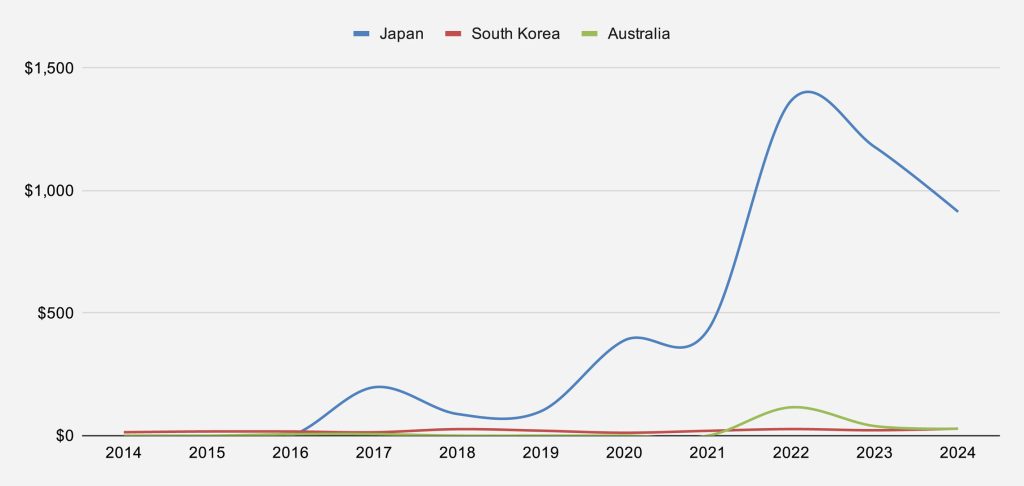
Taken together, ODA allocations across Japan, Australia, and South Korea are dominated by transport and economic infrastructure, all of which exposes the structural logic of imperialist globalization, while claiming to align with the interests of recipient countries, but are in contrast with the needs and demands of local communities and civil society organizations. A huge percentage of ODA flows toward middle-income countries with investable returns, and not toward the least developed countries and fragile states where aid is really designed to serve.
Energy transition projects are linked to violations of indigenous land rights and FPIC compliance. While critical minerals and digital sectors are also increasingly positioned as development cooperation priorities, a framing that possesses a deeper political agenda. Japan, South Korea, and Australia all have strategic interests across Asia Pacific in securing minerals and digital infrastructure for their own industrial ecosystems. The use of ODA to advance strategic interests in the name of development cooperation indicates the private capture of development.
There is an urgency for resistance. As donor countries fail to uphold their commitments, what remains are the realities of what much of the international aid system has always been—a tool for advancing donor interests by mobilizing private finance through extending corporate presence in the Global South while claiming to be for “sustainable development”.
By and large, donors must uphold the 0.7% GNI ODA commitment and protect its core mandate: to reduce poverty and inequality. Prioritizing private finance shifts ODA from its true purpose. Development cooperation must focus on the long-term, people-centered, and locally-led development of recipient countries rather than donors’ commercial and geopolitical interests. Development cooperation should be driven by people’s genuine need, and accountable to the communities and sectors it claims to serve.
This article is written by Adrienne Recuya, an intern of Reality of Aid – Asia Pacific.